Independent editorial publication

Editions · September 6, 2026

The Good in the World

A clearer view of human progress.

Education

Brazil spent a decade rethinking high school. Far more teenagers are now finishing it.

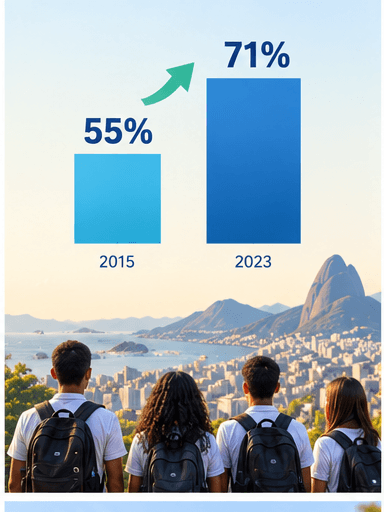
Between 2015 and 2023, upper-secondary completion by age 19 rose from 55% to 71%, while promotion improved, repetition fell and far more students entered full-time schools.

Editorial illustration of Brazilian students beneath a chart showing high-school completion rising from 55 percent in 2015 to 71 percent in 2023.
Editorial illustration. This image does not depict the actual event.

Between 2015 and 2023, the share of Brazilian 19-year-olds who had completed upper-secondary school rose from 55% to 71%.

Over the same period, promotion rates improved, grade repetition was cut in half, age-grade distortion fell and enrollment in full-time schools nearly tripled. The gains show that sustained system reform can keep substantially more teenagers moving toward graduation.

Education reform rarely produces one dramatic moment. It changes timetables, curricula, teacher support, school management and the choices available to students—and then asks whether more young people remain on track years later.

Brazil began a broad effort to rethink upper-secondary education from a difficult starting point in 2015.

At the time, only 55% of young people had completed upper-secondary school by age 19. Nearly three in ten students were two or more years behind the grade expected for their age, and the ordinary school day was short.

By 2023, completion by age 19 had risen to 71%, according to a World Bank assessment of the reform period.

Promotion rates in state schools climbed from roughly 80% to 90%, while grade repetition was cut in half. Age-grade distortion fell from 30% to 21%.

Students also spent more time in school. Enrollment in full-time schools—defined as at least seven hours of instruction a day—rose from about 5% to 17%.

No single policy can claim all of those gains. Brazil's effort included national changes as well as implementation by states, and education outcomes are shaped by economic and social conditions beyond school walls.

The importance of the trend is that several measures moved together in the same direction: more teenagers advanced, fewer repeated grades, fewer fell far behind and many more finished secondary education by 19.

That is the kind of gradual institutional progress that can remain almost invisible when attention focuses only on a single year's test scores or political dispute.

What to Keep in Perspective

Brazil has not solved secondary education.

Learning outcomes remain a serious challenge, and national averages can conceal large differences between regions, schools and groups of students.

The evidence supports a narrower conclusion: over eight years, substantially more Brazilian teenagers progressed through and completed upper-secondary school.

The reporting for this story draws on the following scientific, institutional and independent sources.

Development date
June 25, 2026
First published
September 6, 2026
Updated
No updates
Last reviewed
September 6, 2026