Independent editorial publication

August 2026

The Good in the World

A clearer view of human progress.

Health & Medicine

After decades of trying, a malaria vaccine is saving children's lives

A four-year evaluation in Ghana, Kenya and Malawi found that introducing the world's first malaria vaccine reduced deaths among eligible young children by 13%. Now malaria vaccination is reaching children across 25 African countries.

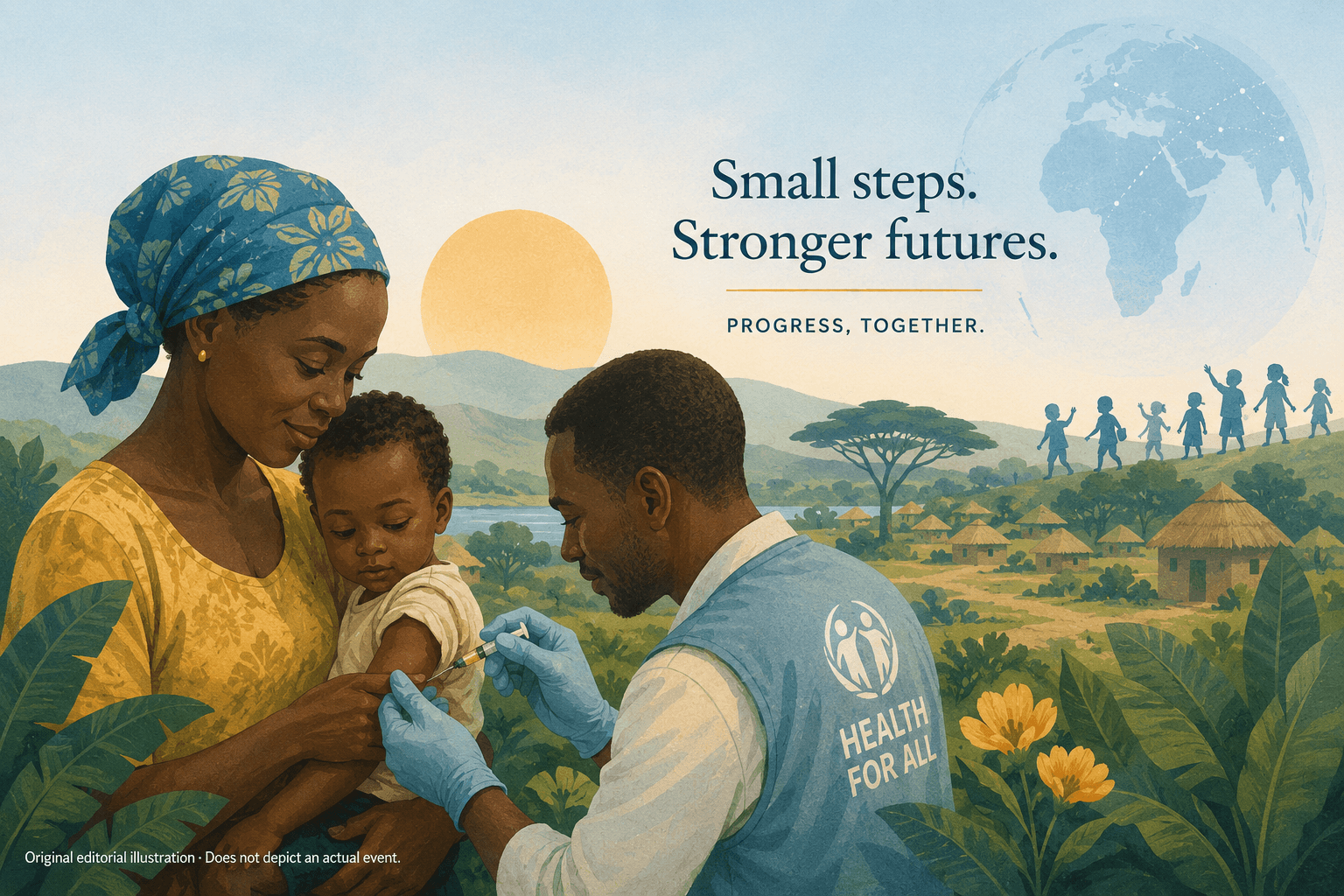
Original editorial illustration of a health worker vaccinating a baby held by their mother in a rural African landscape
Original editorial illustration · Does not depict the actual event.

For decades, scientists pursued something that had never existed: a vaccine against a human parasite. Now there is strong evidence that the result is saving children's lives outside clinical trials.

Researchers evaluating the RTS,S malaria vaccine in Ghana, Kenya and Malawi found a 13% reduction in deaths from all causes other than injury among young children eligible for vaccination—roughly one death averted for every eight that otherwise would have occurred. Severe-malaria hospitalizations also fell by 22%.

The results come from four years of routine vaccine delivery, not an idealized clinical-trial setting.

Today, WHO says 25 African countries are offering malaria vaccines, with more than 10 million children targeted for vaccination each year.

Why It Matters

Malaria remains an enormous killer. WHO estimates that about 438,000 African children died from malaria in 2024.

What makes this result especially significant is that it answers a question clinical trials alone could not:

Does adding malaria vaccination to ordinary childhood immunization programs actually reduce deaths?

The evidence now says yes.

Researchers compared 158 geographic areas, half of which began vaccination earlier while the others served as comparison areas. More than 26,000 community reporters helped monitor child deaths. Other factors—including use of bed nets and uptake of routine childhood vaccines—remained similar between the groups, strengthening confidence that vaccination was responsible for the mortality difference.

A vaccine unlike most others

Malaria has an unusual place in the history of vaccines.

Vaccines train the immune system to recognize a biological threat, but malaria is caused by a parasite rather than a virus or bacterium. Developing an effective vaccine proved extraordinarily difficult.

RTS,S eventually became the first malaria vaccine recommended by the World Health Organization in 2021, followed by a second vaccine, R21, in 2023.

But recommending a vaccine and proving that it changes lives at population scale are different things.

Beginning in 2019, Ghana, Kenya and Malawi introduced RTS,S through ordinary childhood immunization programs in selected areas. More than two million children eventually participated in the Malaria Vaccine Implementation Programme.

The program also created an unusual opportunity to measure what happened next.

From efficacy to lives saved

The four-year evaluation published in The Lancet in May 2026 compared 158 geographic clusters: 79 introduced the vaccine and 79 initially did not.

Researchers tracked deaths among vaccine-age-eligible children and monitored other factors that could distort the comparison.

The result was a 13% reduction in all-cause mortality excluding injury associated with introducing the vaccine.

Hospitalizations for severe malaria declined by 22%.

Using all-cause mortality deserves explanation.

Determining whether malaria caused a child's death can be surprisingly difficult, particularly when a child dies at home without a medical diagnosis. Even in hospitals, malaria infection may be the primary cause, a contributing factor or incidental.

Researchers therefore used deaths from all causes other than injury as their primary mortality measure.

That makes the result broader than counting diagnosed malaria deaths—and potentially more reliable for determining whether introducing the vaccine actually kept children alive.

It worked without perfect coverage

There is another encouraging aspect of the result.

The vaccination program wasn't perfect.

About 71% of eligible children received three doses, while only about 40% received the fourth during the evaluation.

Yet the population-level mortality benefit remained substantial.

That's particularly relevant because the places that stand to benefit most from malaria vaccination can also have health systems facing shortages, conflict, mistrust and difficulty getting families back for repeated appointments.

The implementation problems remain important, but the study shows meaningful reductions in mortality are possible even with moderate coverage.

From three countries to 25

The story has already moved beyond the original pilot.

As of February 2026, WHO reported that 25 African countries were offering malaria vaccines, targeting more than 10 million children annually.

Two vaccines—RTS,S and R21—are now WHO-recommended.

And the scale of the opportunity is enormous.

Malaria caused an estimated 610,000 deaths worldwide in 2024. About 438,000 of those deaths were African children.

WHO estimates that scaling malaria vaccination across moderate- and high-transmission areas could prevent approximately half a million child deaths by 2035.

That figure is a projection, not an accomplished result.

What comes next

The scientific breakthrough is increasingly becoming an implementation challenge.

Countries need money to purchase vaccines and maintain vaccination programs. Children need to receive multiple doses. Bed nets, treatment and other malaria interventions need to continue alongside vaccination.

But something fundamental has changed.

For much of modern medical history, a malaria vaccine was an objective researchers were trying to reach.

Today there are two WHO-recommended vaccines, millions of children have received them, and a large real-world evaluation has found that introducing vaccination reduced childhood mortality.

The promise has become measurable progress.

What to Keep in Perspective

This is another weapon against malaria, not a replacement for the others.

WHO recommends malaria vaccination alongside insecticide-treated nets, diagnosis, medicines and other prevention measures.

The vaccine requires four doses, and completing that schedule remains difficult. During the pilot, about 71% of eligible children received three doses and only about 40% received the fourth.

There is also a major practical constraint. Vaccine supply is currently sufficient to meet demand, according to WHO, but funding is preventing many countries from reaching their national vaccination targets.

So this is not malaria solved.

It is something more precise—and still remarkable:

We now have strong evidence that malaria vaccination can prevent children from dying when incorporated into real health systems.

The reporting for this story draws on the following scientific, institutional and independent sources.

  • The Lancet — Mwapasa et al., 2026Primary source · Primary scientific source · May 2026

    Four-year evaluation of RTS,S introduction in Ghana, Kenya and Malawi.

  • World Health OrganizationPrimary source · Primary / institutional source · May 8, 2026

    WHO assessment of the newly published mortality findings.

  • World Health OrganizationPrimary source · Primary / institutional source · February 4, 2026

    Current vaccine recommendations, rollout, malaria burden and scale-up constraints.

  • London School of Hygiene & Tropical MedicineIndependent source · Expert / research institution · May 8, 2026

    Explanation of study design and use of all-cause mortality.

  • BMJIndependent source · Independent medical reporting · 2026

    Independent coverage of the Lancet findings.

Development date
May 8, 2026
First published
August 16, 2026
Updated
No updates
Last reviewed
August 16, 2026