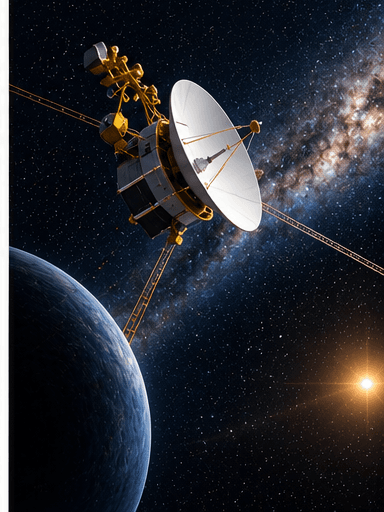
Voyager 1 was built for a planetary tour, not for nearly half a century of exploration.
It launched from Cape Canaveral on September 5, 1977, following Voyager 2 into space but taking a faster trajectory toward the outer planets.
At Jupiter, its instruments and cameras helped transform a distant point of light into a complex world system. Voyager 1 discovered a thin ring around the planet and two moons, Thebe and Metis.
It continued to Saturn, where it found five additional moons and the G-ring while returning observations that deepened scientists' understanding of the planet and its satellites.
The spacecraft's path then carried it away from the plane of the planets and toward a different kind of frontier.
In August 2012, Voyager 1 crossed the heliopause and entered interstellar space—the first human-made object known to do so.
NASA currently lists Voyager 1 as an extended mission. Engineers continue managing its shrinking power supply and aging instruments across a distance so great that a one-way radio signal takes almost a day to travel.
Its longevity is not one uninterrupted triumph. The mission has required decades of careful engineering, diagnosis and decisions about which systems can remain active as available power declines.
What makes Voyager 1 remarkable is the accumulation: a machine created with 1970s technology completed its planetary mission, crossed into a region no spacecraft had reached and continued returning information across generations of human lives.
Forty-nine years after launch, the exploration did not end with nostalgia. It is still happening.